26/02/2013

London galleries: highlights (19/02/13)

I was lucky enough to get a space on the coach last week to London to see the Manet show at the RA. It was fairly last minute so, with no set agenda, I took a Galleries guide and just spent the day on a whim.

As the RA was very busy and my ticket was timed, I took a wander down Cork Street to see what was going on. First stop was Flowers, where there was a survey of Claerwen James' portraiture, which was fresh to me and which I found to be quite captivating. Aesthetically, James' palette is very appealing to me while the flat, graphic delivery of the paint onto the surface really sings. They retain a painterly quality all the while, however, which is perhaps achieved by the use of oil on board. Conceptually, the paintings evoke a mysterious sense of stillness and unease, created by using photographs as a basis for the works. In the press release, the artist is said to believe that the photographs are "crucial to the painful, elegiac quality of the paintings."

Claerwen James, "Barefoot girl in yellow", 2006

Next I had a peek in Redfearn Gallery a few doors down, where there was a mixed exhibition of painting, print and collage. Small scale works that caught my eye were by John Minton, Patrick Proctor and Keith Vaughan, while at the other end of the scale was an eye-catching drawn piece entitled "Head" [1965] by sculptor Elisabeth Frink.

The current exhibition at Browse and Darby is of work by Patrick George, who deals mainly in landscapes. While his painting style is effective and precise, really I was impressed by the works on paper which displayed great levels of draughtsmanship and technical expertise. On display were studies of people, animals, boating scenes which were all of an extraordinary quality.

Patrick George, "Dining room chair"
I was enticed inside Marlborough Fine Art by the fascinating display in the window. Paula Rego was showing "Dame with the goat's foot and other stories", a series of recent works on paper that were based on the curious display: a disconcerting group of lifeless, life-size dolls, humanoids, animals and hybrids were arranged eerily in a group, like the cast of a bizarre pantomime. The resulting pastel-conte-charcoal works follow suit in their creepy, narrative style.

Paula Rego, "School for little witches", 2009

At last I made it inside the Royal Academy, where "Manet: Portraying Life" was proving to be very popular. I made notes on several of the paintings, with particular reference to their technique and style over any other aspect. The paintings of his wife, Suzanne Leenhoff (Mme. Manet) were interesting because of their rapid and vital direction. It is suggested that their unfinished state indicates that they were not intended for public exhibition. Furthermore, "Woman with a cat" gives an indication of Manet's way of working; the rushed, 'sketchy' piece features long, zig-zag brushstrokes which suggest a kind of crosshatch technique to Manet's underpainting. There is a strong physicality to many of the works on display, the markmaking evokes a sense of intense creativity and it is easy to picture Manet as a fervent and passionate artist at work. In contrast; the more finished, official-looking paintings lack the life-force and immediacy of the aforementioned works. I appreciate the opportunity to see the artist's process; Manet is presented as a painter of enormous imagination and vivacity.
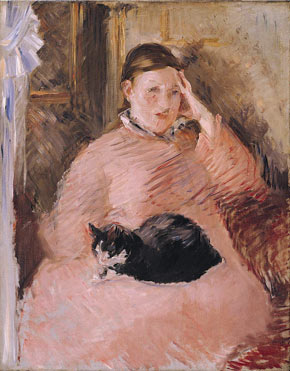
Edouard Manet, "Woman with a cat", 1880-2
After lunch I decided to head to the National Portrait Gallery to have a look at the contemporary wing. I was glad to have gone as it was a great source of ideas for my own work. "Three Royal Court theatre directors" [2004] by Justin Mortimer was a pleasant surprise, as I had not expected to see his work there and have only seen it on paper. Up close the work is captivating and painterly, and of a high quality that I've come to expect from Mortimer. I also got  a glimpse of Marlene Dumas' recent "Amy Blue" painting, which gained a lot of press when it was first shown. It seemed to me to be a rather elementary painting in it's style and the actual canvas was primed with a horrible white which, although deliberate, I couldn't help but dislike the aesthetic of it. There was a room dedicated to Humphrey Ocean's ongoing "A handbook of modern life" series, which I loved. Here he is creating a continuous journal of life experience and encounters with his contemporaries, something which I am currently aspiring to do in my work. Another work which struck me was Maggi Hambling's charcoal study of Stephen Fry [1993]; a highly accomplished and expressive piece which retains a loose, rhythmic effect.

Humphrey Ocean, "Felix", 2007
Finally I made a brief stop at the ICA where Juergen Teller's "Woo!" exhibition was on. The large scale photographs of a nude Vivienne Westwood were surprising and mildly titilating to me, while his series of photographs "Irene im Wald" showed a more personal, reflective side to the unconventional photographer. One room was plastered with spreads from magazines that he'd created, featuring humourous, posed and naked photos of himself, supermodels, designers and celebrities. These were mostly amusing and pleasing to the eye, whereas the more formal photographs upstairs were captivating for their more human, inward-looking style. Altogether the show was light relief after a day of looking at paintings. I wonder why photography is, at times, easier to look at? I don't feel such a need to find meaning or criticism for a photograph in the same way that I do for a painting.

Overall, the day was unexpectedly informative to my practice, and I gained a good insight into the current practices of artists I hadn't expected to before.


26/12/2012

Some questions for Laurence Elliott

One artist that caught my attention at this years' Modern Alchemists exhibition was Laurence Elliott. A graduate of Glasgow School of Art, his captivating paintings are a self-deprecating saga of life events and political and social subtext. I wanted to ask him a few questions about his work - below is the correspondence. Laurence's portfolio is available here.
 
'As above, so below' by Laurence Elliott
 
Ruth Hitchens: Is there a rigid process to your work? Do you follow any sort of cursory procedure in order to create paintings?
Laurence Elliott: I basically do what I think most painters and illustrators do. I have an idea and try to keep it as visually simple as possible, but I'm following 11 years worth of tailored new years resolutions which mean that there's more readings there for anyone who pays proper attention and for me to be thoroughly entertained during the sometimes many years struggle to birth these things. 
I try to draw everything on poor quality paper in marker pens, so that I'm left with dots where my hand pauses. I find this very helpful because it means the work can be farmed, combined, etc. [see below.] I always try to have a few drawn versions of anything before I'll think of painting anything. It rarely works the other way round. It has to be funny & serious. I test them out in a range of drugged, low blood sugared and drunken states, to see if I was lying on any level and to see if they'll inspire lyrics. I've got to get my kicks, or how the hell can anyone else!?!

 
'We all fight the grief' by Laurence Elliott
 
R.H: In your portfolio you mention plundering source material from everywhere, are there any particular places or people that have become a part of your work?
L.E.: Of course. I collect a true current crime magazine from Glasgow called the digger and try to find images of the gang that tried to kill my flatmate that God helped me stop and eventually get the money for this laptop. My friend James Dick is a brilliant portrait painter, so when he heard of my fight with the law over my attempted murder, he willingly gave me photographs of Glasgow's procurator fiscal. I use old photographs of myself and family. Myself, because I like the idea of documenting the decay & fall of a 'golden boy'. 
I collect pictures of Jordan's family, real people magazine, Jade Goody & TV drama actors, particularly Ian Beale at Pauline's funeral.
 
R.H.: How was art school? Did you feel the need to shake the experience off when you graduated?
L.E.: Art school was brilliant for finding the people I needed to know. It's an industry. I want to teach because I know my stuff and imagine it'd be mutually beneficial. When I was in 2nd year (3rd in Scotland), Transmission gallery put me in a group show which meant all the other ambitious collegues of mine turned on me with some real venom. When I realised that I'd probably never be able to pay my loan back because of taking it all very seriously and also in jest, there were things I wanted to shake off, but there's a lot I miss about it.

'Crossing the brook' by Laurence Elliott
R.H.: How has this year compared to previous years in your practice? Where can you see it going?
L.E.: This year was good for making work, and it was the latest. Thats all I can really say. I need a studio and have just gone self-employed, aiming to screen print hoodies and t-shirts and make money from several chasm's I see in the market. I've got favours to call in from various publications. When Xmas is over and I've done all the paperwork I need to do, get a studio and paint again. I've been concentrating on getting my new zine book together and preparing a lot of drawings to become print. Writing songs. It will go further, but I expect many more years crippling poverty. But am REALLY PSYCHED & PUMPED about what I plan to do.

R.H.: What's your outlook for the future of painting and fine art?
L.E.: Such a lot obviously depends on the economy. I just want people to be serious about their fun in this field. For years I've been aching and wishing for the most extreme form of everything mutated together in a dirty rich broth. That nourishes the soul and sense of humour. It's what my efforts have been based around for a long time. Technologically speaking I think it could be really exciting with new print technologies, techniques and methods, holograms and projected sounds so a few individuals think they're going nuts & act up.
I want the wars to stop, especially the war on drugs and that money put into culture. If that happens, it'll be really thrilling but I think people swallow the towed line waaaay too easily and the power is vain and proud and not really concerned, I feel.
 
With thanks again to Laurence for his time, I'll be interested to see what follows.

21/12/2012

Phil Collins at Artes Mundi 5: Critical review


Out of the seven artists nominated for this year’s Artes Mundi prize, Phil Collins is the only Brit on the shortlist. However, his endeavours are as international as any other, as shown by the work he has produced for the exhibition, and his profile as an artist. Collins has shown work across Britain, Europe, Australia and the US and shows no sign of slowing pace.

The Cardiff-based prize is in its fifth year, having established itself as a visual arts initiative aiming to “provide an opportunity for wider discussion of the role of artists in society.” Other artists represented in the prize this year are Teresa Margolles, Tania Brugera, Miriam Bäckström, Apolonija Šušteršic, Darius Mikšys and Sheela Gowder. The works on show span enormously in their formal differences, however a thread of social engagement runs through all of the selected pieces. Collins’ part in Artes Mundi is perhaps one of the more traditional - if such a term still applies - forms of contemporary visual art.

Born in Cheshire, the now Berlin-based artist has put forward two pieces for the prize, installed across two sites: free fotolab is an automated slide projection based in the contemporary gallery of the National Museum Wales, and This Unfortunate Thing Between Us (otherwise abbreviated to TUTBU) is a video installation at Chapter Arts Centre in Cardiff.

Free fotolab began in 2004 as a curatorial project in Milton Keynes. Collins offered a service to the public to develop their 35mm films in exchange for the right to use them any way he saw fit. This element of voyeurism is crucial to the work; without it, Collins is just a lab technician at Jessops (as he once was).  The project went on to expand and exhibit across Europe, and the resulting slide installation in the Museum is a culmination of years of processing, analysing and archiving.

The premise of free fotolab is to question the reproduced image; Collins is probing the boundary between the ownership of these images and the exploitation of the subjects within them and their original creator. They are surrendered to Collins willingly by the original author, to be appropriated as he sees fit, therefore the slideshow before us is not made up of covert or found photographs, but of images selected for a special purpose. Accordingly, the images presented in free fotolab are evidence of the beauty of the snapshot and perhaps even the fragility of human interaction. As an audience, we marvel at the mystery of them: who took the photograph, where and when it was taken, why was it selected? These questions shroud the piece in a nostalgic presence, which at best appeals to aesthetic conventions, but may be considered to conceal the meaning of the piece.

Accompanying free fotolab for Collins entry is This Unfortunate Thing Between Us, a two-part recording of a scripted teleshopping channel, broadcast in Berlin last year on live television. The recordings are shown on screens in two caravans parked outside Chapter. TUTBU tv is a parody of consumerism, where the viewer has the option to purchase one of three life experiences: the chance to be interrogated, Stazi-style, on live television; to play a part in a period-drama sex scene; or to wake up on your deathbed and tell your loved ones exactly what you think of them.

It makes for compelling viewing. Beneath the comedy and quirkiness of the actors garish costumes and wigs, there is an underlying sense of commercially-tinted unease. Collins dissection of the teleshopping format brings the issue of modern desire to question in an explicit and demanding way. Although it seems that there is no clear, forceful message through the piece, the viewer is undeniably made to consider his or her own agenda in relation to it.

Of the two pieces, TUTBU is probably the more revealing of Collins motives as an artist; his practice is highly referential to popular visual communication and in particular, the television programmes which utilise reality in their production inform the work in several ways. We are confronted with a hyper-real version of the everyday, prompting a heightened consciousness of our own lives. Now Phil Collins asks: is this what we have become? More specifically, he asks: how does the camera produce us? By using television as a way to propose opportunity, Collins engages with the notion of communication as an art form. This is nothing especially new to the arts scene, and Collins has been leading to this for several years, however the platform on which the work is distributed offers a different way of thinking through seeing. In the work we discover ourselves, and our own experience of human joyousness, suffering, indifference - Collins does not put a name on it, but offers us its meaning instead.

The key motive that forms the basis of his work is the investigation of human behaviour under the influence of contemporary media. Speaking recently at the Artes Mundi conference at the National Museum, Collins revealed a little more about the works: “snapshots were referred to in derogatory terms but they were remarkably beautiful to me … the centrality of an object which holds an account of memory [is] related to trauma and life experience. What are the modes of address in which we record emotional landscape?” It appears that Collins, as an artist, is oriented towards the mediums that document life itself.

Regardless of winning the £40,000 prize awarded for Artes Mundi, it appears that Collins will inevitably gain a wider audience through his populist approach. Screening TUTBU live on German television has made him a name in the arts scene there, and with the Artes Mundi prize coinciding with the more recognised Turner prize this year (which he was once short listed for) perhaps this will be a year to remember for Phil Collins.